
Understanding Peptides vs SARMs vs SERMs: Where the Category Lines Are is essential for anyone navigating the modern landscape of biotechnology and performance research. While these three classes of compounds are frequently discussed in the same breath across wellness and biohacking forums, they operate through entirely different biological mechanisms. From targeted cellular signaling to selective receptor modulation, distinguishing their distinct pathways is crucial for interpreting current scientific literature.
What Are Peptides? Cellular Messengers and Signaling Molecules
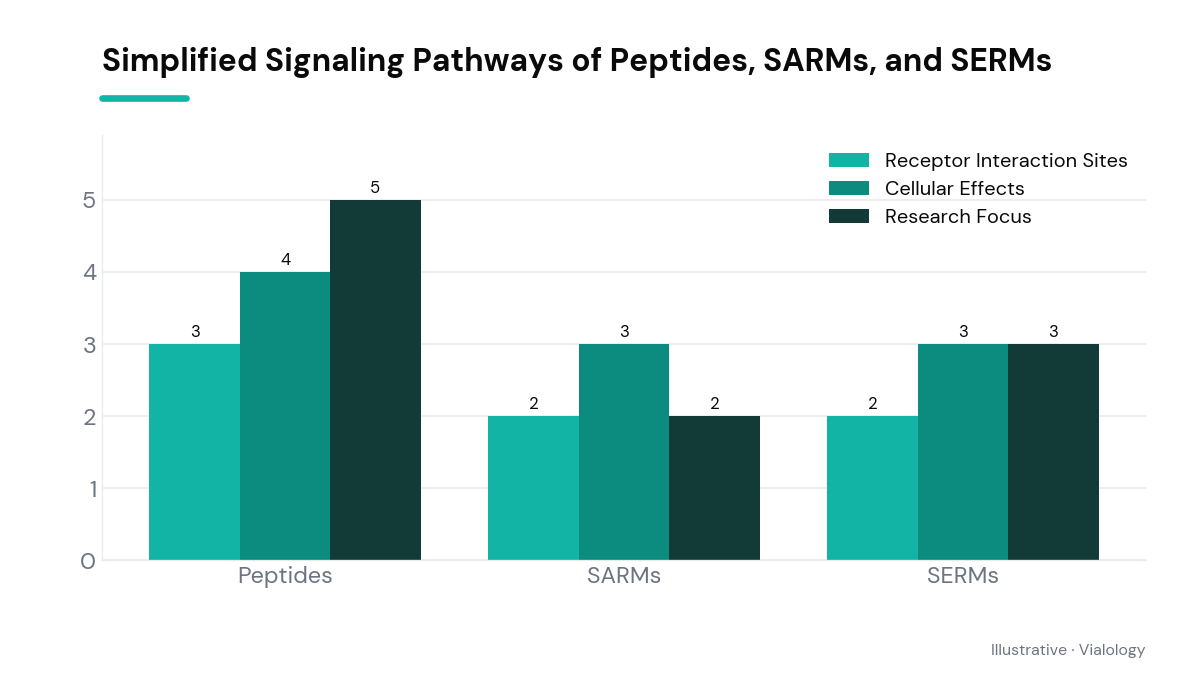
Peptides are short chains of amino acids, typically consisting of 2 to 50 monomers linked by peptide bonds. Unlike proteins, which are larger and more structurally complex, peptides act primarily as precise signaling molecules within the endocrine and paracrine systems. In human biology, endogenous peptides like insulin, oxytocin, and growth hormone-releasing hormones coordinate vital physiological processes by binding to specific cell-surface receptors, triggering cascades that influence metabolism, tissue repair, and immune function.
In clinical research, synthetic peptides are designed to mimic these natural signaling pathways. For instance, secretagogues like CJC-1295 and Ipamorelin are studied for their ability to stimulate the pituitary gland’s natural release of growth hormone. Because they bind to highly specific receptors, therapeutic peptides generally exhibit a favorable safety profile with targeted actions, though researchers note that their rapid degradation in the body often requires specific delivery systems to remain stable.
Decoding SARMs: Selective Androgen Receptor Modulators
Selective Androgen Receptor Modulators, or SARMs, represent a distinct class of synthetic small-molecule drugs designed to interact with the body’s androgen receptors. Unlike traditional anabolic-androgenic steroids, which indiscriminately affect various tissues and can cause widespread systemic changes, SARMs are engineered to target androgen receptors in specific tissues like skeletal muscle and bone while sparing other organs such as the prostate and liver. This tissue-selective activity is why researchers have investigated compounds like Enobosarm (Ostarine) and Ligandrol (LGD-4033) for counteracting muscle wasting diseases and osteoporosis.
However, the regulatory and safety profile of SARMs differs significantly from peptides. The U.S. Food and Drug Administration (FDA) has issued multiple warnings noting that SARMs are not approved for human consumption and can carry risks of liver toxicity, cardiovascular events, and natural testosterone suppression. For a deeper dive into how these compounds compare directly in experimental models, you can peptides vs SARMs vs SERMs to see how researchers delineate their safety profiles.

Understanding Peptides vs SARMs vs SERMs: The Role of Estrogen Regulation
Selective Estrogen Receptor Modulators (SERMs) represent the third category, operating in a manner structurally analogous to SARMs but focusing instead on the body’s estrogen pathways. SERMs function as competitive antagonists or agonists of estrogen receptors depending on the target tissue. For example, classic SERMs like Tamoxifen (Nolvadex) and Raloxifene act as estrogen antagonists in breast tissue—making them critical tools in oncology research—while acting as estrogen agonists in bone tissue, helping to maintain bone mineral density.
In research contexts, SERMs are highly valued for this dual nature, allowing scientists to block the unwanted proliferative effects of estrogen in sensitive tissues while preserving its beneficial metabolic and structural effects elsewhere. Unlike peptides, which act as broad-spectrum cellular messengers, both SARMs and SERMs are small-molecule modulators that specifically compete with endogenous sex hormones for receptor occupancy, altering gene transcription at the nuclear level.
Key Structural and Mechanistic Differences
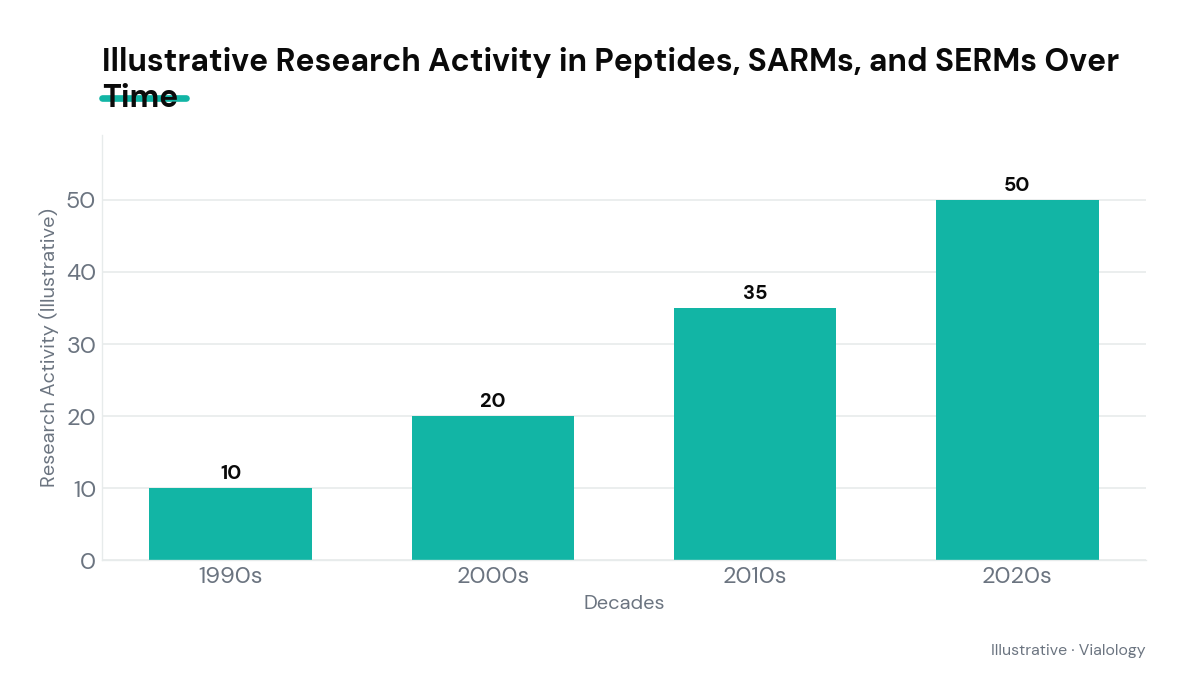
The fundamental difference among these groups lies in their chemical structures and target receptors. Peptides are amino-acid-based polymers that act on cell membrane receptors to initiate intracellular signaling cascades, whereas SARMs and SERMs are non-steroidal, small-molecule compounds that cross cell membranes to bind directly to nuclear hormone receptors. This structural disparity dictates how the body metabolizes, tolerates, and responds to each substance, highlighting why they cannot be used interchangeably in experimental designs.
Related on Vialology
Frequently asked questions
What is the main difference between a peptide and a SARM?
Peptides are short chains of amino acids that act as cellular messengers by binding to cell-surface receptors, whereas SARMs are synthetic small molecules that specifically target and activate androgen receptors inside muscle and bone cells.
Are SERMs used for muscle growth like SARMs?
No, SERMs specifically modulate estrogen receptors rather than androgen receptors and are primarily researched for their ability to block or mimic estrogen in specific tissues like breast and bone.
Are any of these compounds approved by the FDA?
While several synthetic peptides and SERMs have received FDA approval for specific medical conditions, SARMs remain unapproved for human use and are restricted to laboratory research settings.
Do peptides suppress natural hormone production like SARMs and SERMs can?
Most research peptides do not suppress the hypothalamic-pituitary-gonadal axis because they mimic natural signaling hormones rather than introducing exogenous sex-hormone receptor agonists into the system.
Educational use only. Vialology publishes journalistic and educational content about peptide science. Nothing here is medical advice, diagnosis, or treatment, and nothing should be taken as an endorsement to use any substance. Many peptides discussed are experimental and are not approved by the FDA for human use. Always consult a licensed healthcare professional before making any health decision.