
Understanding how to dilute lyophilized research compounds can be complex, which is why researchers frequently turn to a peptide reconstitution calculator to ensure precise experimental measurements. These digital tools mathematically resolve the relationship between dry powder mass, diluent volume, and final concentration. By demystifying the ratios involved, scientists can accurately measure specific micrograms within a standard insulin or syringe.
The Science of Lyophilization and Reconstitution
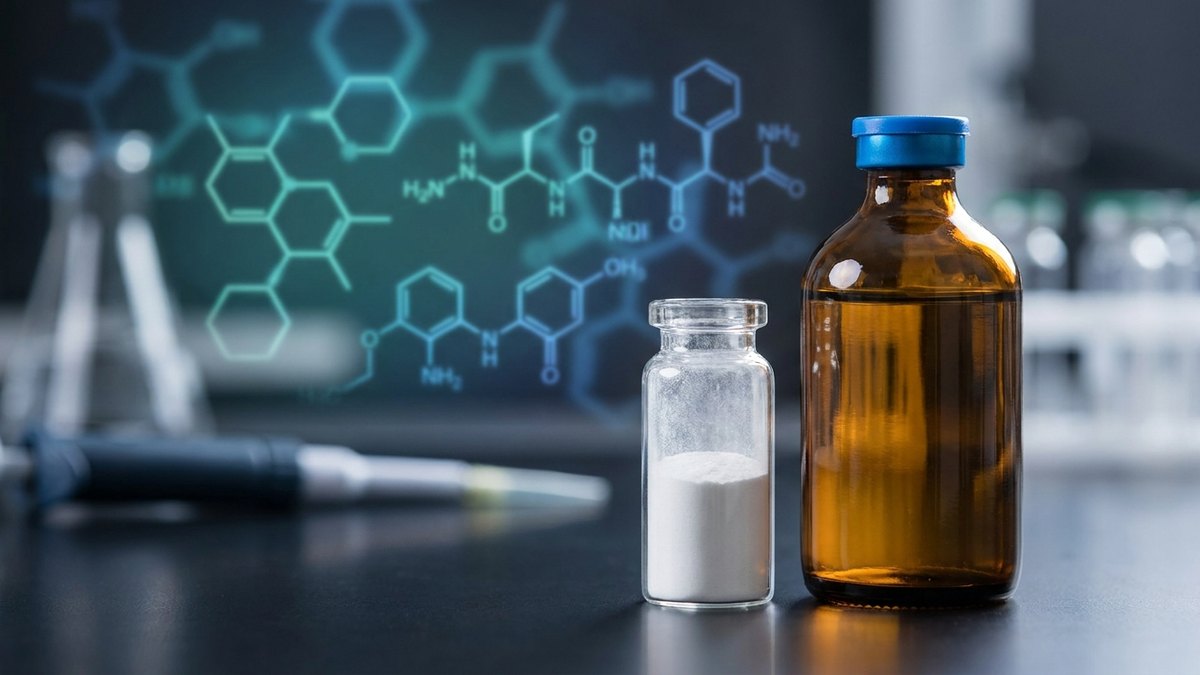
Peptide therapeutics and research agents are typically manufactured as lyophilized (freeze-dried) powders stored in peptide vials to ensure chemical stability. In this state, the fragile peptide chains are protected from degradation caused by heat, light, and moisture. Reconstitution is the precise scientific process of introducing a sterile diluent—most commonly bacteriostatic water containing 0.9% benzyl alcohol as a preservative—back into the vial to yield a homogeneous liquid solution.
The concentration of the resulting solution depends entirely on two variables: the total mass of the peptide in the vial (measured in milligrams, or mg) and the volume of the diluent added (measured in milliliters, or mL). Because researchers deal with microgram (mcg) dosages, even a slight mathematical error during this liquid phase can skew experimental results significantly.
Deciphering the Math Behind a Peptide Reconstitution Calculator
To eliminate human error, a peptide reconstitution calculator automates the conversion math between milligrams, milliliters, and insulin syringe units. Standard syringes are calibrated in “units,” which are measurements of volume rather than active ingredient mass. For example, in a standard U-100 syringe, 100 units equal exactly 1 milliliter of liquid. Therefore, a single unit represents 0.01 mL.
A typical calculation determines how many micrograms of the active compound exist within each individual unit of the syringe. If a researcher reconstitutes a 5 mg vial of a peptide with 2 mL of bacteriostatic water, the final concentration is 2.5 mg per mL. Translated into standard syringe metrics, each individual unit (0.01 mL) of this solution contains exactly 25 micrograms of the peptide.
Syringe Types and Volumetric Measurements in Research
Precision in laboratory settings relies heavily on choosing the appropriate syringe scale, typically categorized as U-100 or U-40. The “U” designation historically refers to insulin units per milliliter, but in broader peptide research, it serves as a standardized volumetric guide. Because U-100 syringes are the industry benchmark, most online reconstitution tools default to this calibration, where 10 units equal 0.1 mL.
Utilizing the wrong syringe type can lead to a tenfold error in volumetric delivery. For instance, a U-40 syringe requires 40 units to reach 1 mL, making each unit significantly larger (0.025 mL) than a U-100 unit. Researchers must align their physical hardware with the mathematical inputs of their calculator to maintain rigorous protocol standards.
Best Practices for Maintaining Solution Integrity
Beyond mathematical accuracy, preserving the structural integrity of the peptide during reconstitution is critical. Peptides are highly delicate sequences of amino acids held together by relatively weak peptide bonds. Forceful injection of bacteriostatic water directly onto the lyophilized powder can cause shear stress, potentially denaturing the compound and rendering it inactive for research purposes.
Instead, standard laboratory protocols dictate aiming the diluent stream against the glass wall of the vial, allowing the liquid to gently cascade down and dissolve the powder naturally. Gentle swirling, rather than vigorous shaking, is utilized to complete the dissolution process. Once reconstituted, these solutions generally require refrigeration to prevent rapid thermal degradation.


Related on Vialology
Frequently asked questions
What is bacteriostatic water and why is it used?
Bacteriostatic water is sterile water containing 0.9% benzyl alcohol, which acts as a preservative to inhibit bacterial growth, allowing the reconstituted solution to be accessed multiple times for research.
How do you convert milligrams (mg) to micrograms (mcg)?
To convert milligrams to micrograms, multiply the milligram value by 1,000 (for example, a 5 mg vial contains 5,000 mcg).
Why does the syringe unit not always equal the peptide dose?
Syringe units measure liquid volume, not active ingredient weight; the actual dose per unit depends entirely on how much diluent was added to the dry peptide mass.
Educational use only. Vialology publishes journalistic and educational content about peptide science. Nothing here is medical advice, diagnosis, or treatment, and nothing should be taken as an endorsement to use any substance. Many peptides discussed are experimental and are not approved by the FDA for human use. Always consult a licensed healthcare professional before making any health decision.