
When evaluating options for growth hormone secretagogues, researchers frequently compare sermorelin vs ipamorelin to understand how these compounds influence endocrine signaling. Both peptides are designed to stimulate the release of endogenous growth hormone from the pituitary gland, yet they do so through distinct biological pathways. By examining their unique mechanisms, clinical histories, and binding affinities, scientists can better understand their respective roles in laboratory research.
Sermorelin vs Ipamorelin: Understanding the Mechanisms
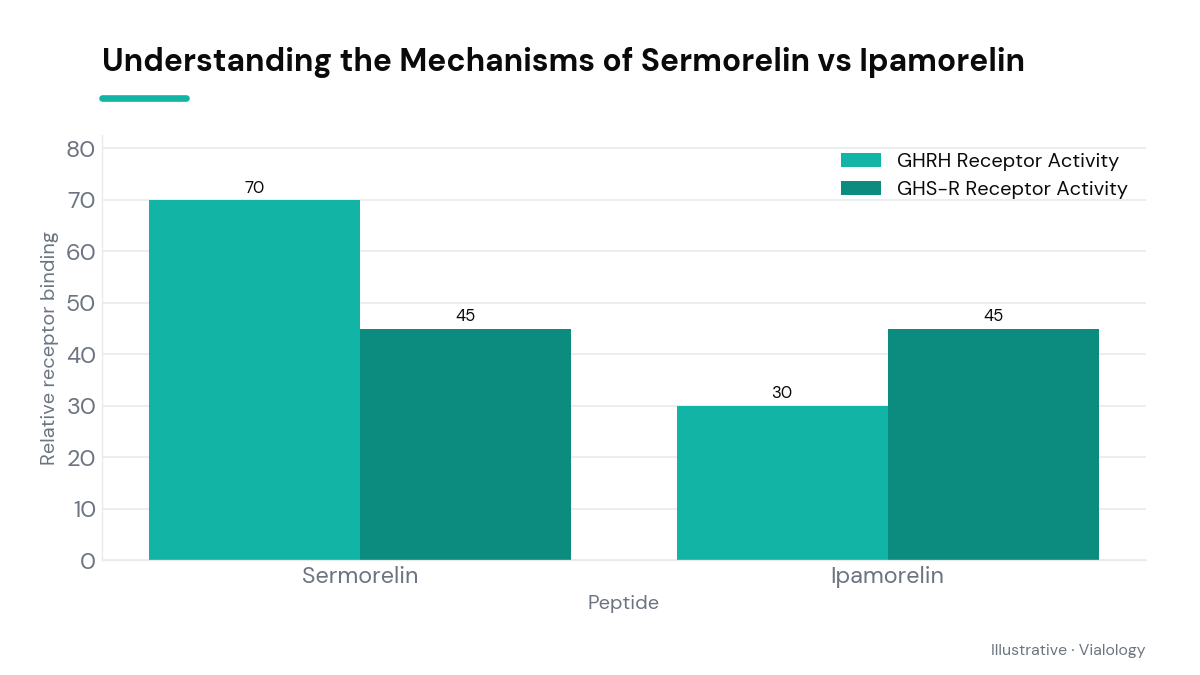
To understand the differences between these secretagogues, we must examine how they interact with the endocrine system. Sermorelin is a synthetic 29-amino acid peptide that functions as a growth hormone-releasing hormone (GHRH) analogue. It mimics natural GHRH by binding to the GHRH receptor on the anterior pituitary gland, triggering episodic growth hormone secretion. Because it relies on natural feedback loops, it preserves pulsatile GH release, avoiding the extreme spikes associated with synthetic human growth hormone.
Ipamorelin belongs to a different class of secretagogues known as ghrelin receptor agonists, or growth hormone-releasing peptides. It selectively binds to the growth hormone secretagogue receptor in the pituitary and hypothalamus. Unlike older compounds in its class, ipamorelin does not significantly stimulate stress hormones like cortisol or hunger-inducing hormones like prolactin. This high selectivity makes it a compelling subject of study, especially when researchers evaluate sermorelin vs ipamorelin side by side to compare molecular pathways.
The Evolution of GHRH Analogues and GHRPs
Sermorelin has a long history in peptide research, developed in the late 20th century and FDA-approved in 1997 for diagnostic use and pediatric growth deficiencies, though later discontinued commercially. It represents the shortest fully functional fragment of natural GHRH, containing the first 29 amino acids of the chain. Clinical trials showed that its administration stimulated the pituitary safely without desensitizing target receptors over prolonged periods, establishing a baseline for secretagogue research.
Ipamorelin is a newer pentapeptide developed in the late 1990s as a highly selective growth hormone-releasing peptide. Acting on the ghrelin receptor rather than the GHRH receptor, it utilizes an entirely different signaling cascade. Instead of directly mimicking GHRH, it synergizes with endogenous GHRH while suppressing somatostatin, the hormone that inhibits growth hormone release. While ipamorelin underwent phase II clinical trials for postoperative ileus, it remains an investigational compound not FDA-approved for human use.
Comparing Half-Life and Biological Activity
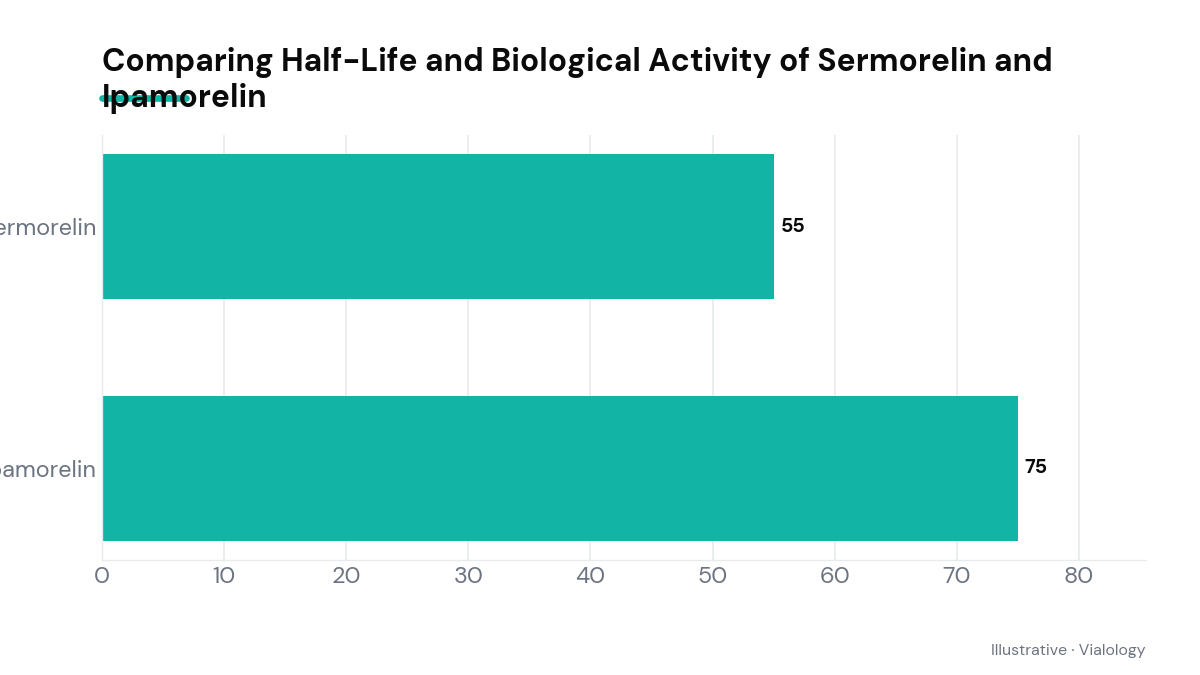
A key difference between these peptides lies in their pharmacokinetic profiles. Sermorelin has a very short biological half-life in vivo, estimated at 10 to 20 minutes, as it is rapidly degraded by blood enzymes. Its pituitary stimulation is rapid but brief, mirroring the natural, pulsatile bursts of growth hormone that occur during deep sleep cycles, making it a highly physiological research model.
In contrast, ipamorelin exhibits a longer half-life, estimated at approximately two hours in animal models. This extended duration allows for a sustained signaling window, leading to a larger cumulative release of growth hormone per administration. Because ipamorelin avoids elevating cortisol and prolactin, researchers can isolate the effects of growth hormone secretagogue receptor activation without confounding endocrine variables.
Research Directions and Synergy Potential
In laboratory settings, research often focuses on potential synergy rather than choosing one over the other. Because sermorelin and ipamorelin stimulate growth hormone via independent pathways—the GHRH receptor and the ghrelin receptor—they can act synergistically. Animal studies suggest co-administration of GHRH and GHRP analogues results in a growth hormone release greater than the sum of their individual effects, as the two pathways amplify intracellular signaling.
While both compounds offer valuable insights into metabolism, tissue repair, and endocrine regulation, they are strictly research chemicals. Clinical research continues to investigate how these specific mechanisms influence body composition and cellular health, though large-scale human trials are still required to fully map their long-term profiles.
Related on Vialology
Frequently asked questions
Is sermorelin or ipamorelin better for muscle growth?
In research settings, neither peptide is FDA-approved for muscle building. While both stimulate pathways influencing protein synthesis, ipamorelin’s longer half-life offers a distinct profile compared to the rapid action of sermorelin.
Do sermorelin and ipamorelin cause the same side effects?
While both are well-tolerated in animal studies, they target different receptors. Sermorelin targets GHRH receptors, while ipamorelin targets ghrelin receptors, avoiding the cortisol and prolactin elevations seen with other secretagogues.
Can sermorelin and ipamorelin be studied together?
Yes, in laboratory research, co-administering GHRH analogues like sermorelin with ghrelin receptor agonists like ipamorelin has shown a synergistic effect, releasing more growth hormone than either compound can produce alone.
Educational use only. Vialology publishes journalistic and educational content about peptide science. Nothing here is medical advice, diagnosis, or treatment, and nothing should be taken as an endorsement to use any substance. Many peptides discussed are experimental and are not approved by the FDA for human use. Always consult a licensed healthcare professional before making any health decision.