
Navigating the complex landscape of laboratory research requires a keen understanding of reconstitution and measurement, which is why we created “A Buyer’s Guide to Peptide Vial Sizes: Matching mg Strength to Your Study’s Dose Range” to help researchers optimize their experimental protocols. Selecting the appropriate milligram (mg) capacity for a lyophilized peptide vial is not merely a matter of convenience, but a critical factor in maintaining molecular stability and preventing unnecessary compound waste. This guide explores the relationship between absolute vial mass, planned dilution volumes, and study duration to assist in precise experimental design.
Understanding Lyophilized Peptide Masses
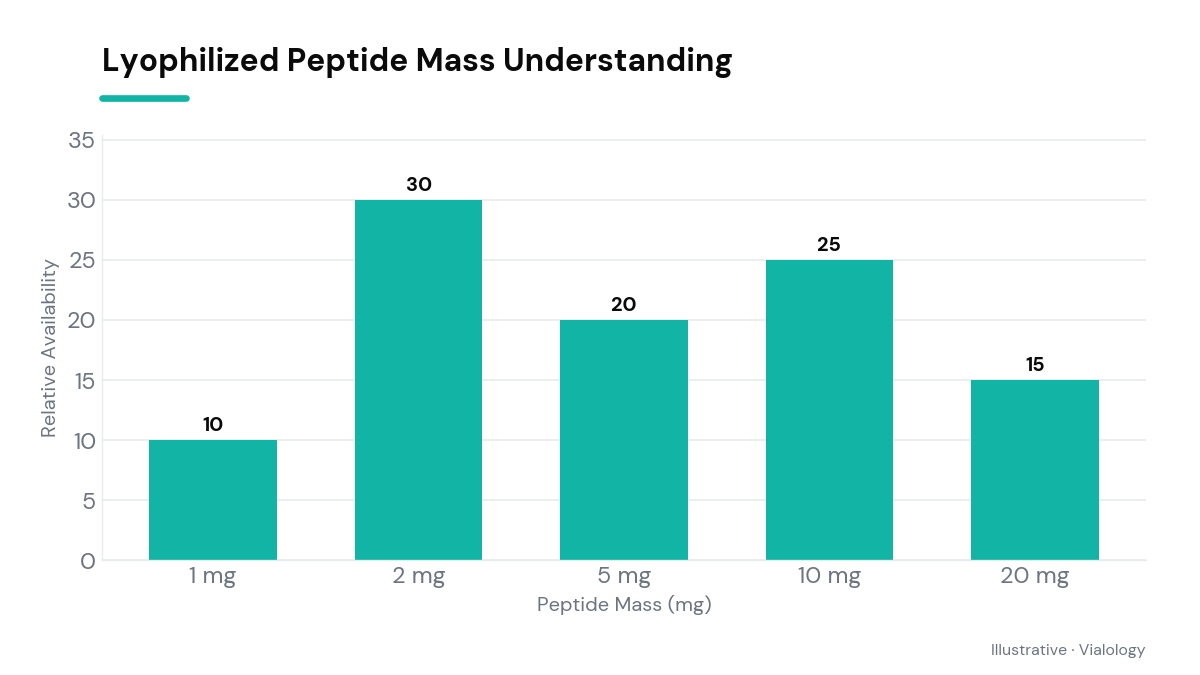
In laboratory research, peptides are typically supplied as lyophilized (freeze-dried) powders sealed under vacuum in glass vials. The mass indicated on the label, such as 2 mg, 5 mg, or 10 mg, refers to the total weight of the active peptide compound contained within that specific vial, excluding any bulking agents, salts, or stabilizers added during the manufacturing process. Understanding this distinction is vital because a 10 mg vial of a peptide does not mean the visible powder itself weighs exactly 10 mg, but rather that it contains 10 mg of the specific active peptide sequence.
When researchers initiate an in vitro or in vivo study, the concentration of the final reconstituted solution directly dictates how much solvent (typically bacteriostatic water or sterile saline) must be added to the vial. For instance, a higher total mass in a single vial offers more flexibility for high-dose protocols but can introduce significant stability challenges if the study extends over several weeks. Therefore, understanding the relationship between the mass of the dry powder and the planned volume of liquid is the first step in successful protocol preparation.
A Buyer’s Guide to Peptide Vial Sizes: Matching mg Strength to Your Study’s Dose Range in Practice
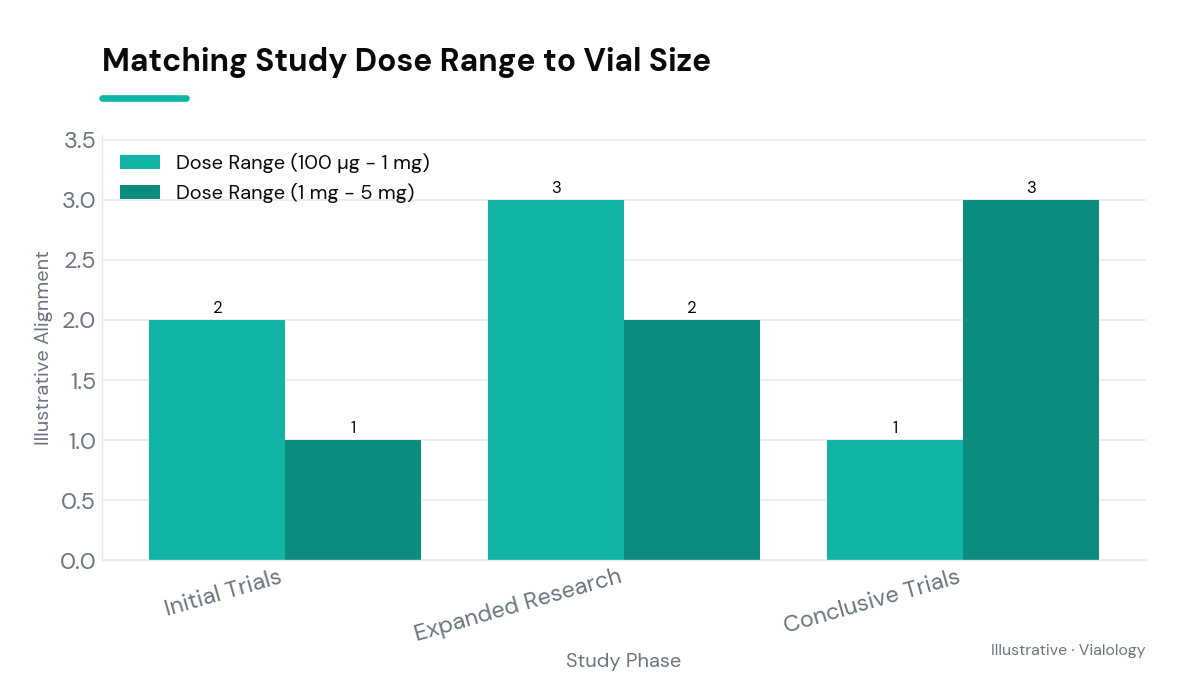
Translating milligram vial sizes to microgram (mcg) study doses is a fundamental step in research planning. A single 5 mg vial contains 5,000 micrograms of a peptide. If an animal model protocol requires a daily administration of 250 mcg, that single vial provides exactly 20 doses. However, if the protocol calls for 1,000 mcg per subject daily, a 5 mg vial will be depleted in just five days, meaning a larger vial size or multiple smaller vials must be prepared to maintain continuity in the trial.
Researchers must also account for the physical volume of the diluent when planning these calculations. Administering too much liquid to achieve a specific target dose can disrupt tissue homeostasis in animal models, while using too little diluent makes precise measurement highly difficult. Utilizing choosing the right vial size as a primary planning step ensures that the resulting concentration allows for manageable, highly accurate micro-measurements on standard laboratory syringes without compromising the integrity of the study.
Chemical Stability and the Degradation Clock
Once a lyophilized peptide is reconstituted with a bacteriostatic agent, its molecular structure begins a slow, inevitable process of degradation. Peptides are held together by delicate peptide bonds that are highly susceptible to hydrolysis, temperature fluctuations, and physical agitation. While lyophilized powders can remain stable at sub-zero temperatures for months or even years, reconstituted peptides generally should be utilized within 14 to 28 days, even when kept under strict refrigeration between 2°C and 8°C.
This chemical shelf-life limitation makes vial selection crucial. If a study requires low doses over a prolonged period, purchasing a large 10 mg vial might result in significant peptide degradation before the solution is fully utilized, potentially skewing experimental results. In such cases, purchasing multiple 2 mg vials and reconstituting them sequentially as needed preserves the integrity of the compound, ensuring that subsequent cohorts receive the same high-purity active ingredient without loss of potency.
Aligning Vial Size with Research Budgets and Wastage
Economic efficiency in research design goes beyond the simple cost-per-milligram metric. Often, larger vial sizes (such as 10 mg or 20 mg) offer a lower unit price per milligram compared to 2 mg or 5 mg options. However, this apparent discount quickly disappears if a substantial portion of the reconstituted peptide degrades and must be discarded. Researchers must balance the upfront discount of bulk vials against the scientific necessity of using pristine, un-degraded chemical compounds.
Additionally, physical loss during the reconstitution process—often referred to as “dead volume” left in the vial’s neck or syringe hub—can disproportionately affect smaller vials. When working with 2 mg vials, a loss of 0.1 ml of solution represents a larger percentage of the total active compound than it would in a 10 mg vial reconstituted with a larger volume of solvent. Planning for these physical and chemical variables ensures optimal resource allocation and high-quality data generation.
Related on Vialology
Frequently asked questions
Why do different peptide vials containing the same mass look like they have different amounts of powder?
This variation is typically due to the presence of non-active bulking agents or excipients, such as mannitol, which are added during the lyophilization process to stabilize the cake and do not reflect the actual active peptide mass.
How long does a reconstituted peptide remain stable in a standard refrigerator?
Most reconstituted peptides maintain high stability for approximately 14 to 28 days when refrigerated between 2°C and 8°C, though specific degradation rates depend heavily on the peptide’s unique amino acid sequence.
Is it better to buy one 10 mg vial or two 5 mg vials for a month-long study?
For a month-long study, opting for two 5 mg vials is generally superior, as it allows you to keep the second vial lyophilized and stable until the first half of the study is completed.
What is the risk of using a peptide vial that has been reconstituted for too long?
Over time, hydrolysis breaks down the peptide chains into inactive fragments, which decreases the concentration of the active compound and can lead to inconsistent or inaccurate research results.
Educational use only. Vialology publishes journalistic and educational content about peptide science. Nothing here is medical advice, diagnosis, or treatment, and nothing should be taken as an endorsement to use any substance. Many peptides discussed are experimental and are not approved by the FDA for human use. Always consult a licensed healthcare professional before making any health decision.