
When exploring the scientific literature surrounding tissue repair, understanding the parameters of a potential bpc-157 dosage is a primary focus for researchers. This synthetic gastric peptide, derived from a protective protein found in human gastric juice, has garnered significant interest for its potential regenerative properties. However, because it remains an unapproved investigational compound, current scientific understanding relies heavily on laboratory models and animal research.
The Context of BPC-157 Dosage in Scientific Literature
In laboratory settings, researchers typically determine experimental protocols based on body weight calculations derived from animal models. Most published literature on Body Protection Compound 157 (BPC-157) utilizes rodent models, where the peptide is administered to evaluate its effects on tendon, muscle, and ligament healing. To translate these animal findings into a human context, scientists utilize allometric scaling—a mathematical method that converts animal doses to human equivalent doses based on body surface area rather than simple weight-for-weight translation. This methodology is crucial because direct conversion can lead to toxic overdosing or sub-therapeutic underdosing, emphasizing why rigorous scaling frameworks are mandatory in translational medicine.
While there is no standardized or FDA-approved BPC-157 dosage for clinical use, researchers analyzing literature trends often document a range of 1.5 to 10 micrograms per kilogram of body weight in animal subjects. These investigative amounts help establish a baseline for safety profile assessments in pre-clinical trials. Because human clinical trials remain extremely limited, establishing a definitive, universally accepted therapeutic protocol remains a challenge for the broader scientific community. Most current databases compiling these metrics do so strictly for comparative academic research, highlighting the vast gap between laboratory exploration and clinical standardization.
Experimental Routes and Administration Methods
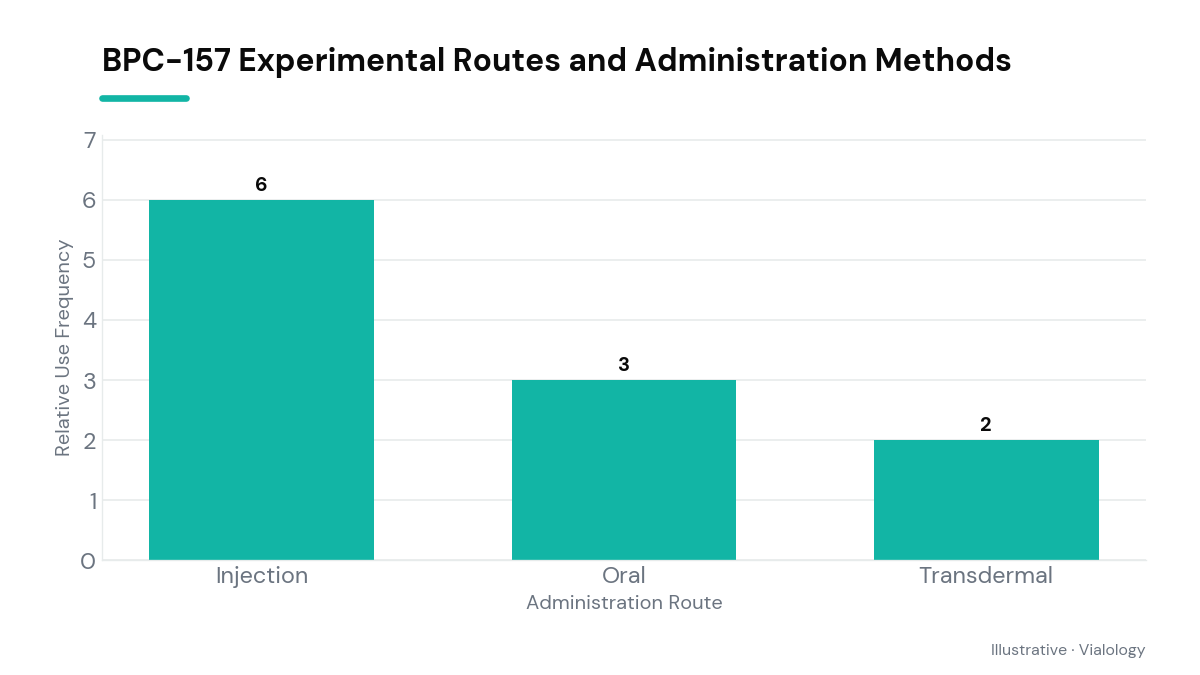
In vivo studies generally investigate BPC-157 through various administration routes, primarily subcutaneous injections or oral delivery. The choice of delivery method often depends on the specific physiological target being studied. For instance, research focusing on systemic soft tissue repair or joint recovery frequently employs subcutaneous administration near the injury site, whereas studies investigating inflammatory bowel conditions or gut-barrier integrity tend to utilize oral stable gastric pentadecapeptide formulations. Each pathway exhibits distinct pharmacokinetic profiles, influencing how quickly the peptide enters systemic circulation and interacts with target receptors.
To organize these diverse experimental protocols, scientists often refer to a dosage reference chart compiled from literature reviews. These reference tools synthesize data from decades of rodent studies, helping to clarify how different administration routes impact bioavailability and systemic distribution. However, researchers emphasize that oral administration faces different metabolic barriers, such as gastric acid degradation, compared to direct injection routes. Understanding these variables is essential for laboratory scientists attempting to replicate prior study outcomes or design new in vitro and in vivo models.
Evaluating Safety Profiles and Translational Limitations
Despite the wealth of promising animal data suggesting accelerated angiogenesis and collagen synthesis, robust human clinical trials are virtually non-existent. The compound is not approved by the U.S. Food and Drug Administration (FDA) for human use, and major athletic organizations, including the World Anti-Doping Agency (WADA), have prohibited its use in competitive sports. Consequently, much of the public discussion regarding its efficacy and safety profiles relies on self-reported anecdotal data from the biohacking community rather than controlled, peer-reviewed human trials. This lack of regulatory oversight means that commercially available products marketed to consumers are unregulated and present significant purity and safety risks.
This gap in clinical literature underscores the need for rigorous, double-blind studies to evaluate long-term safety, potential side effects, and toxicological thresholds. Pre-clinical models have shown a high safety margin with minimal adverse effects, but animal physiology does not always predict human responses accurately. Until formal clinical trials are conducted, any discussion of human application remains speculative. Researchers must proceed with caution, relying exclusively on established laboratory protocols to guide their investigations into this gastric peptide.
Related on Vialology
Frequently asked questions
Is BPC-157 FDA approved for human consumption?
No, BPC-157 is not approved by the FDA for human use or therapeutic administration and remains classified as an investigational research chemical.
What is the primary source of BPC-157 dosage data?
Most dosing data originates from animal studies, specifically rodent models, which researchers scale to estimate hypothetical human equivalents.
Are there known side effects of BPC-157?
While animal models report high tolerability, the lack of rigorous human clinical trials means the full profile of potential side effects in humans remains largely unknown.
Educational use only. Vialology publishes journalistic and educational content about peptide science. Nothing here is medical advice, diagnosis, or treatment, and nothing should be taken as an endorsement to use any substance. Many peptides discussed are experimental and are not approved by the FDA for human use. Always consult a licensed healthcare professional before making any health decision.