
As the science of cellular aging advances, identifying the best research peptides has become a primary focus for investigators analyzing metabolic health, mitochondrial function, and cellular senescence. These short chains of amino acids serve as highly targeted molecular tools, allowing researchers to probe the intricate biological pathways that govern how organisms age. While human applications remain largely experimental, preclinical investigations continue to yield compelling data regarding their potential to influence lifespan and healthspan.
Epitalon and Telomere Biology
Epitalon, a synthetic tetrapeptide modeled after the naturally occurring pineal peptide epithalamin, remains one of the most widely studied compounds in longevity research. First synthesized in the late 20th century by researchers at the St. Petersburg Institute of Bioregulation and Gerontology, its primary mechanism of action is hypothesized to involve the upregulation of telomerase. This enzyme helps maintain telomere length, which typically shortens as cells divide and age. In rodent models, long-term administration of Epitalon has been documented to increase lifespan, reduce spontaneous tumor incidence, and restore circadian rhythms.
While these preclinical animal models are promising, robust clinical data in humans is still limited. Researchers analyzing cellular aging pathways often utilize Epitalon in vitro to observe how telomerase activation affects cellular senescence and replicative capacity. Due to its targeted action on DNA preservation mechanisms, it is frequently cited as one of the most intriguing candidates in laboratory-based aging research.
Mitochondrial Targets: The Best Research Peptides for Cellular Energy
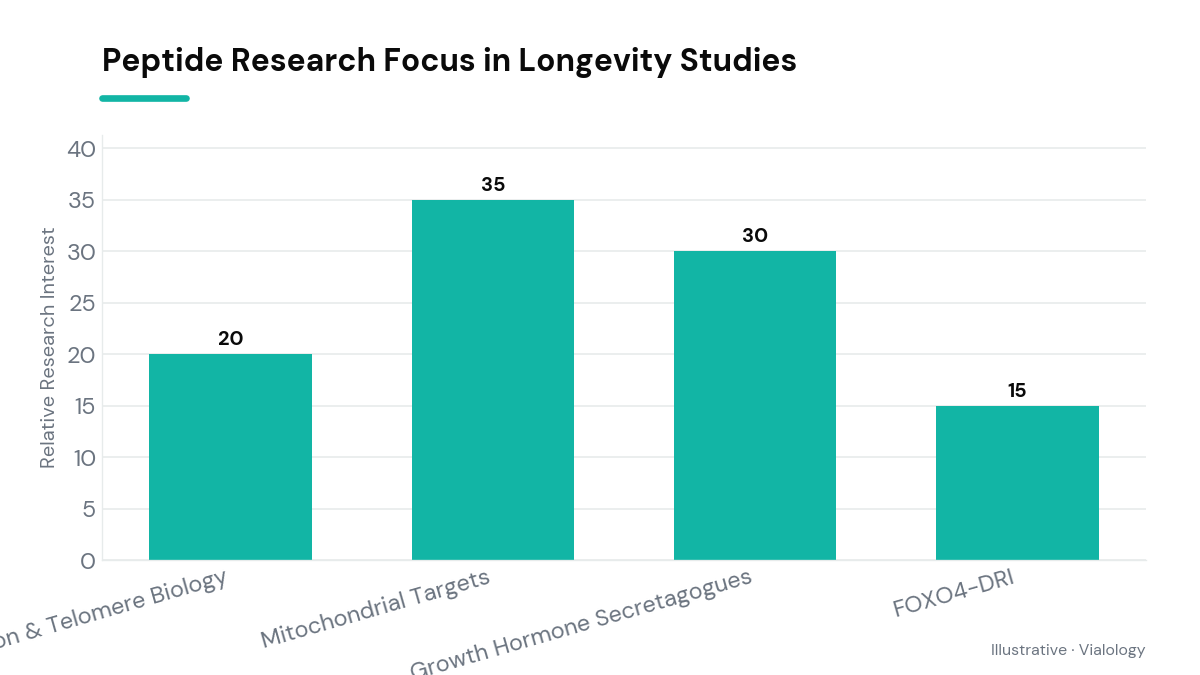
Mitochondrial dysfunction is a recognized hallmark of aging, leading researchers to focus heavily on mitochondria-derived peptides. Among these, MOTS-c has emerged as a key regulator of metabolic homeostasis and cellular energy. Discovered in 2015, this 16-amino-acid peptide acts primarily on skeletal muscle to enhance glucose metabolism and promote physical capacity. In mouse models, MOTS-c has been shown to prevent age-associated insulin resistance and physical decline, prompting deeper inquiry into how these signals communicate between the mitochondria and the cell nucleus.
Another prominent mitochondrial therapeutic candidate is SS-31, also known as Elamipretide, which targets the inner mitochondrial membrane lipid cardiolipin. By stabilizing cardiolipin, SS-31 helps restore mitochondrial structure, optimize ATP production, and reduce harmful reactive oxygen species. For laboratories investigating cellular energetics, sourcing the best research peptides for longevity studies often starts with these mitochondrial-targeted agents, as they directly address the bioenergetic decay associated with advanced cellular age.

Growth Hormone Secretagogues: CJC-1295 and Ipamorelin
The decline of growth hormone levels with age, a phenomenon known as somatopause, is associated with reduced muscle mass, increased adipose tissue, and diminished cellular repair. Research peptides like CJC-1295, a GHRH analog, and Ipamorelin, a ghrelin receptor agonist, are studied for their ability to stimulate the pituitary gland to release endogenous growth hormone in a pulsatile manner. Unlike synthetic growth hormone therapy, which can cause erratic spikes, secretagogues work within the body natural feedback loops, making them highly valuable for researchers studying tissue regeneration and body composition changes in aging models.
When evaluated in preclinical settings, these peptides demonstrate synergistic effects, particularly in enhancing protein synthesis, promoting lipolysis, and improving sleep architecture in animal subjects. However, because both CJC-1295 and Ipamorelin are investigational substances not approved by the FDA for general anti-aging therapies, laboratory studies remain focused on defining their precise receptor-binding kinetics and long-term safety profiles.
FOXO4-DRI and the Clearance of Senescent Cells
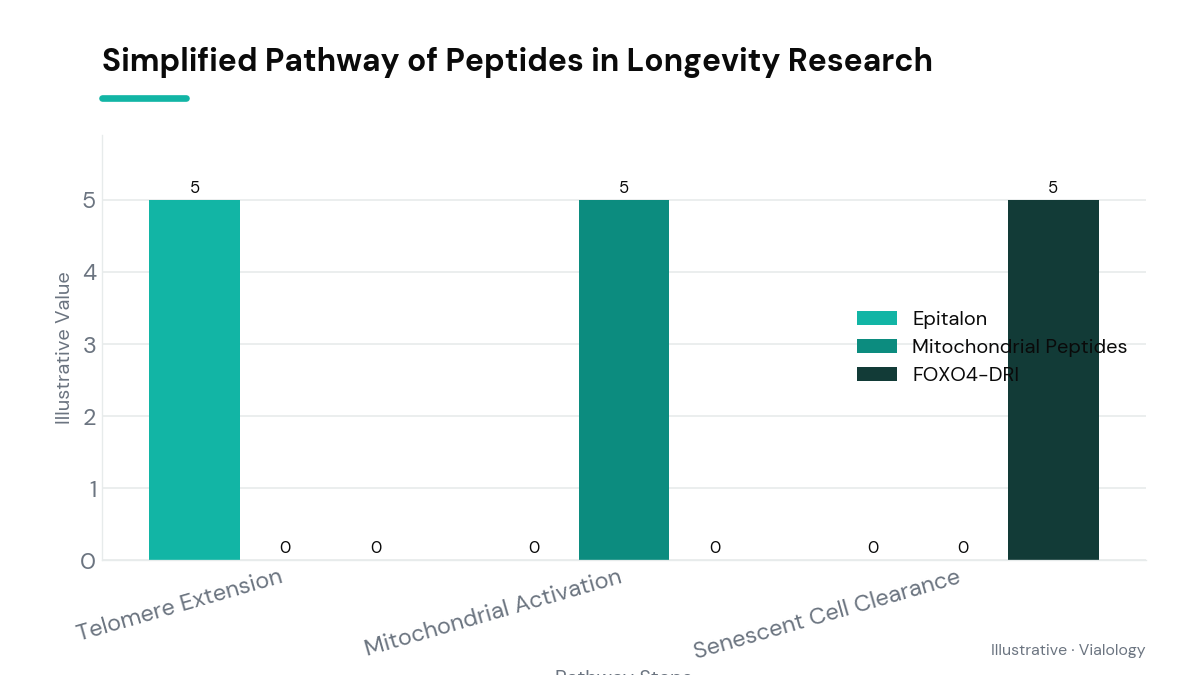
Cellular senescence, the state where damaged cells refuse to die and instead secrete inflammatory signals, is a primary driver of tissue degeneration. To address this, researchers are studying senolytic peptides like FOXO4-DRI. This compound is designed to disrupt the interaction between the FOXO4 transcription factor and the p53 tumor suppressor protein. When this interaction is blocked, senescent cells are targeted for apoptosis while healthy cells are left intact, representing a major breakthrough in targeted cellular clearance.
A landmark 2017 study in mice demonstrated that FOXO4-DRI administration neutralized senescent cells, restored hair density, improved kidney function, and increased overall running wheel activity in aging mice. While these results have ignited massive interest in the biotechnology sector, the compound remains strictly in the pre-clinical stage. Current research focuses on understanding its systemic toxicity and refining its delivery mechanisms to ensure selective apoptosis.
Related on Vialology
Frequently asked questions
Are these longevity peptides approved for human use by the FDA?
Most longevity peptides, including Epitalon, MOTS-c, and FOXO4-DRI, are classified as investigational compounds and are not FDA-approved for human anti-aging treatments. They are restricted to laboratory research and in vitro or in vivo animal studies.
What is the difference between a peptide and a growth hormone?
Peptides are short chains of amino acids that serve as signaling molecules, whereas growth hormone is a large, complex protein. Peptide secretagogues like Ipamorelin stimulate the body to produce its own growth hormone rather than introducing synthetic hormones directly.
How do mitochondrial peptides influence the aging process?
Mitochondrial peptides like MOTS-c and SS-31 regulate cellular energy production, reduce oxidative stress, and improve metabolic signaling. By maintaining mitochondrial health, these peptides help counteract the bioenergetic decline that occurs naturally with age.
Educational use only. Vialology publishes journalistic and educational content about peptide science. Nothing here is medical advice, diagnosis, or treatment, and nothing should be taken as an endorsement to use any substance. Many peptides discussed are experimental and are not approved by the FDA for human use. Always consult a licensed healthcare professional before making any health decision.