
In laboratory settings, researchers often rely on a precise peptide calculator to translate dry, lyophilized powders into usable liquid solutions. This dilution process is governed by fundamental principles of volumetric mass concentration and stoichiometry. Understanding the underlying mathematics ensures that experimental assays remain accurate, reproducible, and scientifically sound.
The Core Chemistry: Lyophilization and Reconstitution Basics
In biochemical research, peptides are typically synthesized and then preserved through a process called lyophilization, or freeze-drying. This technique removes water by sublimation under a vacuum, leaving behind a highly stable, solid powder at the bottom of a sealed glass vial. Because these proteins are highly sensitive to thermal degradation and hydrolysis, keeping them in a dehydrated state extends their shelf life and maintains structural integrity until they are ready for experimental analysis.
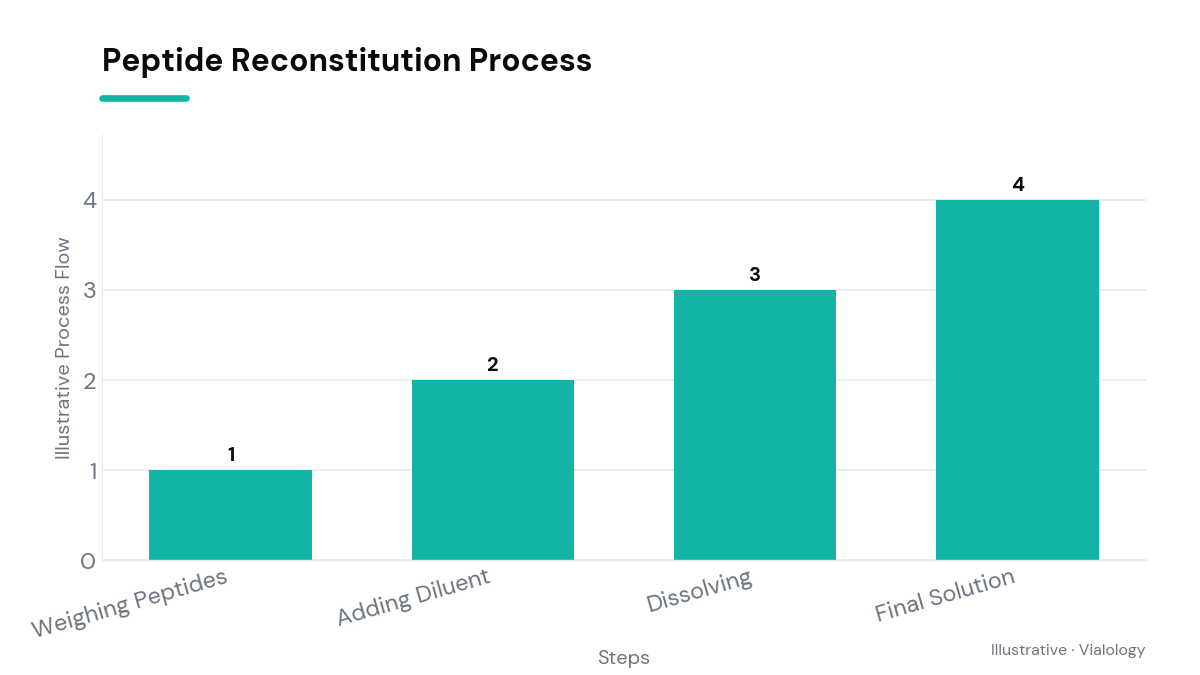
Reconstitution is the process of re-dissolving this freeze-dried powder back into a liquid state using a sterile solvent, or diluent. In scientific laboratories, this diluent is almost always bacteriostatic water or sterile saline. The goal is to create a homogeneous solution with a highly specific concentration, which requires precise mathematical preparation before any liquid ever touches the powder.
The Mathematics Behind a Peptide Calculator
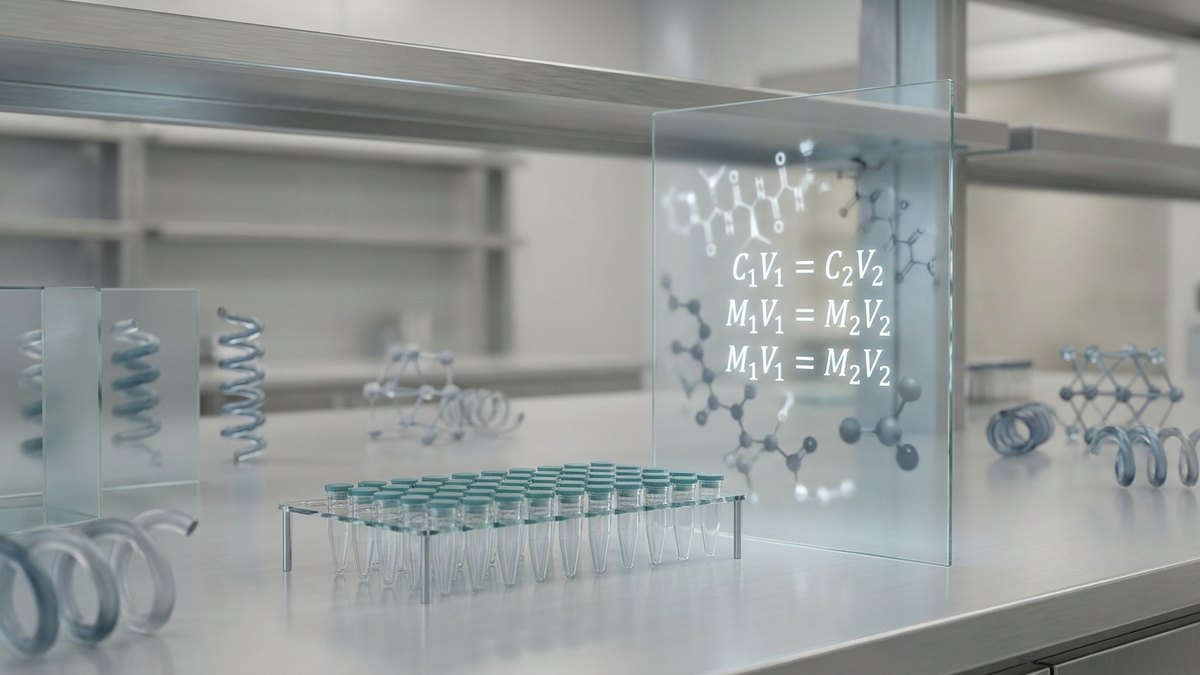
While digital tools like a peptide calculator can streamline laboratory workflows, the underlying math relies on a classic algebraic concentration formula: Concentration (C) equals Mass (M) divided by Volume (V), or C = M / V. When researchers need to determine a specific dose from a reconstituted vial, they use the dilution equation C1V1 = C2V2, where C represents concentration and V represents volume. For example, if a laboratory vial contains 5 milligrams (mg) of a lyophilized peptide and is reconstituted with 2 milliliters (mL) of diluent, the resulting concentration is 2.5 mg per mL, which can also be expressed as 2,500 micrograms (mcg) per mL.
This mathematical precision is vital for cellular assays and animal studies. Because biological responses are highly dose-dependent, even a minor calculation error can lead to under- or over-concentration, potentially skewing experimental results or compromising the validity of a study. Researchers must carefully account for metric units, converting milligrams to micrograms and milliliters to microliters to ensure flawless conversion rates.
Understanding Diluent Dynamics and Solute Displacement
One common question in laboratory mathematics is whether the physical volume of the freeze-dried powder affects the final volume of the solution. In professional research settings, the volume of the lyophilized peptide cake is typically treated as negligible. Because the actual mass of the peptide active ingredient is incredibly small—often just a few milligrams mixed with a tiny amount of bulking agent like mannitol—its displacement of the liquid diluent is statistically insignificant for standard laboratory dilutions.
Consequently, if a researcher adds exactly 2.0 mL of bacteriostatic water to a vial, they can confidently assume the final volume of the liquid solution is 2.0 mL. However, in highly specialized high-concentration formulations or when working with large macromolecular proteins, volume displacement must be calculated more rigorously. For standard synthetic research peptides, the simplified model remains the laboratory standard, ensuring high reproducibility across different batches and experimental trials.
Practical Calibration in Research Environments
To convert concentrations into measurable volume increments, scientists calibrate their laboratory pipettes or syringes based on the calculated microgram-per-microliter ratio. For instance, if a target concentration of 250 micrograms is required for an in vitro assay, and the vial concentration is 2,500 micrograms per milliliter (or 2.5 micrograms per microliter), the researcher divides the target mass by the concentration (250 mcg / 2.5 mcg per microliter) to determine that exactly 100 microliters of solution must be dispensed.
Maintaining precise records of these calculations is fundamental to the scientific method. Variations in solvent temperature, pipetting technique, and calculation errors are the most frequent sources of inconsistency in laboratory research. By mastering these dilution principles and verifying digital tools against manual algebraic equations, researchers preserve the integrity of their data and contribute to more reliable, peer-reviewed scientific literature.
Frequently asked questions
What is the basic mathematical formula behind peptide reconstitution?
The fundamental formula is Concentration (C) equals Mass (M) divided by Volume (V), typically expressed as C = M / V. To calculate subsequent dilutions, researchers use the standard dilution equation C1V1 = C2V2.
Why is lyophilized peptide volume typically negligible in reconstitution math?
The physical mass of the lyophilized peptide powder is so small (often only a few milligrams) that its liquid displacement is statistically insignificant. Therefore, the total volume of the reconstituted solution is assumed to equal the volume of the added diluent.
How do researchers calculate concentration in micrograms per milliliter?
Researchers first convert the total mass of the peptide from milligrams to micrograms by multiplying by 1,000. They then divide this microgram value by the total volume of diluent added in milliliters to determine the concentration in micrograms per milliliter.
What role does bacteriostatic water play in laboratory dilution ratios?
Bacteriostatic water acts as the solvent (diluent) that dissolves the solute (peptide) to achieve the target concentration. Its volume dictates the dilution ratio and final concentration of the active peptide in the solution.
Educational use only. Vialology publishes journalistic and educational content about peptide science. Nothing here is medical advice, diagnosis, or treatment, and nothing should be taken as an endorsement to use any substance. Many peptides discussed are experimental and are not approved by the FDA for human use. Always consult a licensed healthcare professional before making any health decision.