
Understanding the scientific parameters surrounding an igf-1 lr3 dosage requires a deep dive into how researchers configure experimental protocols for this long-acting insulin-like growth factor analog. Developed to overcome the rapid clearance rate of endogenous IGF-1, this synthetic peptide is highly studied in cellular and animal models for its potent anabolic properties. By examining the published literature, we can analyze how scientists structure their laboratory investigations without crossing into clinical recommendations.
The Molecular Evolution of IGF-1 LR3
IGF-1 LR3 is a synthetic analog of human insulin-like growth factor-1 that has been structurally modified to improve its biological half-life. By replacing the glutamic acid at position 3 with arginine (hence “R3”) and adding a 13-amino-acid extension at the N-terminus (making it “Long”), scientists successfully created a peptide that resists binding to insulin-like growth factor-binding proteins (IGFBPs). In native physiology, these binding proteins act as inhibitors, neutralizing up to 99% of circulating IGF-1.
Because IGF-1 LR3 exhibits up to a 120-fold lower affinity for these binding proteins, its active clearance rate is dramatically reduced. While natural IGF-1 has a half-life of only about 10 to 20 minutes in the bloodstream, the LR3 analog remains active for approximately 20 to 30 hours. This prolonged activity makes it an exceptionally potent tool in cell culture and animal studies, allowing researchers to observe downstream signaling cascades with significantly lower or less frequent applications.
Research Trends in IGF-1 LR3 Dosage and Protocols
In laboratory settings, establishing an appropriate experimental protocol depends heavily on the model organism and the specific physiological pathways under investigation. For instance, rodent studies focusing on muscle regeneration, wound healing, or nitrogen retention typically utilize microgram-level quantities adjusted for body weight. Researchers carefully document these configurations, as the compound’s prolonged biological activity increases the risk of systemic side effects, such as hypoglycemia or accelerated organ growth, if the experimental thresholds are exceeded.
For scientists trying to understand these cellular thresholds, consulting a reliable dosage reference can help contextualize how these quantities translate across different animal models and in vitro tissue cultures. In most animal-based literature, researchers opt for highly conservative, localized administrations over short, controlled cycles. This approach helps prevent receptor downregulation, which is a common cellular feedback mechanism that occurs when the IGF-1 receptor (IGF-1R) is continuously overstimulated.

Physiological Impacts and Receptor Interaction
Once introduced into an experimental system, the peptide binds directly to the IGF-1R, initiating the intracellular PI3K-Akt-mTOR pathway. This biological cascade is the primary driver of protein synthesis, cellular proliferation, and skeletal muscle hypertrophy. Because IGF-1 LR3 circulates freely without the regulating influence of binding proteins, cellular models demonstrate a marked acceleration in the proliferation of myoblasts—the precursor stem cells responsible for muscle repair and growth.
However, this lack of binding-protein regulation also highlights why scientific literature emphasizes caution regarding systemic exposure in research subjects. Without natural buffering, the peptide interacts unimpeded with any tissue expressing IGF-1 receptors. This includes not only skeletal muscle but also smooth muscle, cardiac tissue, and potentially neoplastic cells, which is why oncology researchers frequently study IGF-1 inhibitors to halt abnormal cellular proliferation.
Safety Profile and Research Limitations
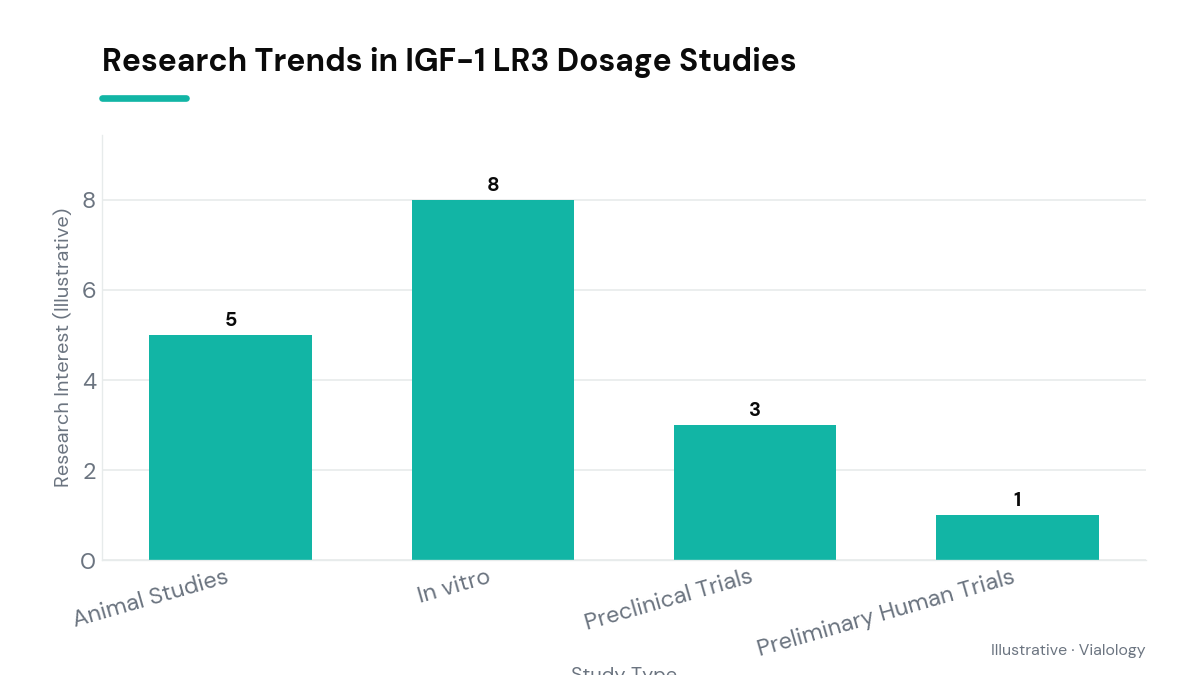
Despite its widespread use in pre-clinical research, IGF-1 LR3 remains an unapproved compound for human therapeutic use, and clinical trials detailing its safety in humans are virtually non-existent. The long half-life that makes it highly effective for laboratory study also introduces significant metabolic risks, most notably insulin resistance and prolonged hypoglycemia. Because IGF-1 shares structural homology with insulin, high concentrations can cross-react with insulin receptors, disrupting glucose homeostasis in animal subjects.
Consequently, contemporary academic research remains strictly focused on animal models and in vitro tissue cultures. Until rigorous, peer-reviewed human trials are conducted to establish safety parameters, pharmacokinetic profiles, and potential therapeutic windows, the compound’s broader physiological impacts on humans remain largely theoretical and speculative.
Related on Vialology
Frequently asked questions
What makes IGF-1 LR3 different from standard IGF-1?
IGF-1 LR3 features a structural modification that reduces its binding affinity to inhibitory proteins, extending its half-life from roughly 15 minutes to approximately 20 to 30 hours.
Is IGF-1 LR3 FDA-approved for human use?
No, IGF-1 LR3 is not approved by the FDA for human consumption or clinical therapy, and it is restricted strictly to laboratory research and in vitro studies.
How does IGF-1 LR3 affect blood sugar levels in research models?
Because of its structural similarity to insulin, the peptide can cross-react with insulin receptors, occasionally causing hypoglycemia in animal subjects during experimental protocols.
Educational use only. Vialology publishes journalistic and educational content about peptide science. Nothing here is medical advice, diagnosis, or treatment, and nothing should be taken as an endorsement to use any substance. Many peptides discussed are experimental and are not approved by the FDA for human use. Always consult a licensed healthcare professional before making any health decision.