
While a digital peptide half life calculator can provide quick mathematical models, understanding the core pharmacokinetics of amino acid chains is essential for predicting how these compounds behave in a laboratory setting. Peptide half-life—the duration required for a substance’s concentration in the body to be reduced by half—determines how rapidly a molecule is cleared by metabolic pathways. For researchers, analyzing these clearance rates is vital for establishing consistent exposure levels in experimental models without triggering cellular desensitization.
Understanding the Science of Peptide Elimination
In pharmacokinetics, a peptide’s half-life is primarily governed by its structural stability and its susceptibility to enzymatic degradation. Unmodified natural peptides, such as endogenous growth hormone-releasing peptides, often possess incredibly short half-lives, sometimes lasting only minutes in plasma due to rapid cleavage by ubiquitous peptidases. To study these molecules effectively, researchers must look closely at how chemical modifications—such as PEGylation, cyclization, or the substitution of D-amino acids—alter this degradation timeline to extend biological activity.
When examining the relationship between peptide half-life and dosing frequency in literature, scientists analyze the steady-state concentration, which is reached when the rate of peptide administration equals its rate of elimination. In animal models, failing to align the research schedule with the drug’s clearance profile can lead to wild fluctuations in plasma levels, rendering experimental data inconsistent or biologically negligible.
Beyond the Peptide Half Life Calculator: Physiological Variables
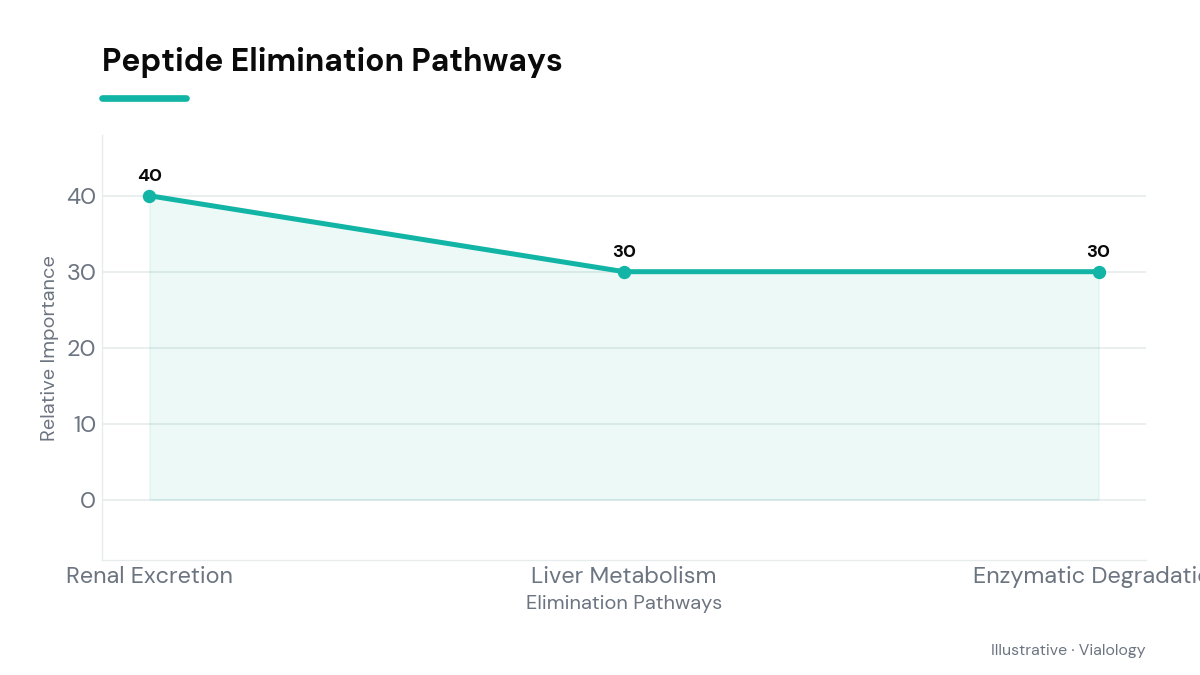
While using a theoretical peptide half life calculator can offer a baseline mathematical projection, biological systems introduce highly complex variables that simple equations cannot fully predict. Factors such as renal clearance, receptor-mediated endocytosis, and vascular perfusion rates drastically influence how long a therapeutic peptide remains active in vivo. For example, a 2019 study on glucagon-like peptide-1 (GLP-1) analogs highlighted how binding to albumin significantly prolongs circulating half-life from minutes to several days by shielding the peptide from enzymatic breakdown.
Furthermore, target receptor saturation plays a critical role in determining active exposure windows. If a peptide binds with high affinity to its target and remains bound, the biological effect may persist far longer than the presence of the free peptide in circulating plasma would suggest, emphasizing that plasma half-life is only one piece of the pharmacokinetic puzzle.
Pharmacokinetic Profiles of Common Research Peptides
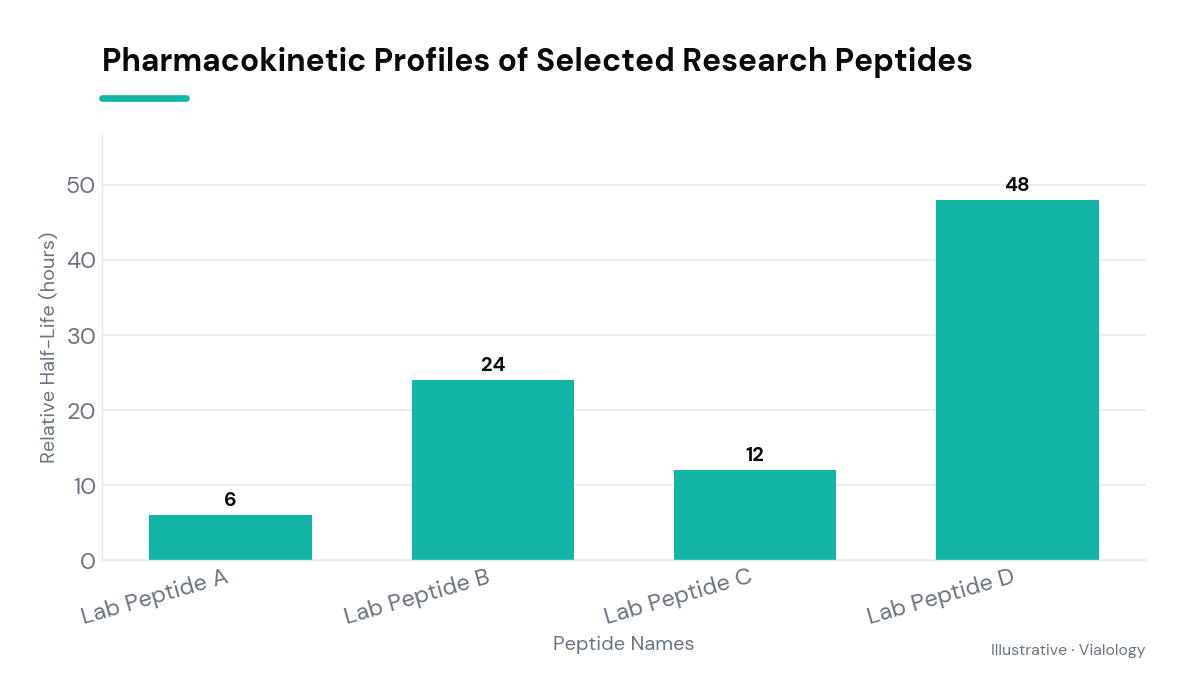
Different classes of research peptides exhibit widely divergent pharmacokinetic profiles. For instance, growth hormone secretagogues like Ipamorelin exhibit a relatively short half-life of approximately two hours in animal models, requiring frequent observational windows to capture peak physiological responses. Conversely, lipidated peptides designed to mimic native hormones can circulate for days, altering the methodology of pre-clinical studies by requiring only weekly assessments to maintain therapeutic levels.
In vitro and in vivo studies must carefully account for these variations to avoid receptor downregulation. Constant, unyielding exposure from long-acting analogs can cause target cells to internalize their receptors, a phenomenon frequently observed in peptide research where continuous stimulation paradoxically diminishes the intended biological response over time.
Related on Vialology
Frequently asked questions
What does the half-life of a peptide mean in research?
In scientific research, a peptide’s half-life refers to the time it takes for its concentration in the bloodstream or target tissue to decrease by 50% due to metabolism and excretion.
Why do some peptides have much longer half-lives than others?
Peptides with modified structures, such as those that are lipidated, PEGylated, or cyclized, resist enzymatic degradation and renal filtration, allowing them to remain active far longer than natural, unmodified peptides.
How do researchers determine steady-state concentration?
Researchers calculate steady-state concentration by balancing the rate of administration with the peptide’s elimination half-life, typically requiring four to five half-lives of consistent exposure to reach equilibrium.
Educational use only. Vialology publishes journalistic and educational content about peptide science. Nothing here is medical advice, diagnosis, or treatment, and nothing should be taken as an endorsement to use any substance. Many peptides discussed are experimental and are not approved by the FDA for human use. Always consult a licensed healthcare professional before making any health decision.