
When investigating oral peptide formulations, understanding “Excipients in Peptide Capsules: What’s Actually in the Capsule Besides the Peptide” is crucial for discerning how these delicate molecules survive the digestive tract. While the active peptide gets all of the attention in scientific literature, it typically makes up only a tiny fraction of the physical capsule’s contents. The remaining volume is occupied by a complex matrix of inactive ingredients engineered to protect, stabilize, and facilitate the absorption of the active compound.
The Role of Excipients in Peptide Capsules: What’s Actually in the Capsule Besides the Peptide
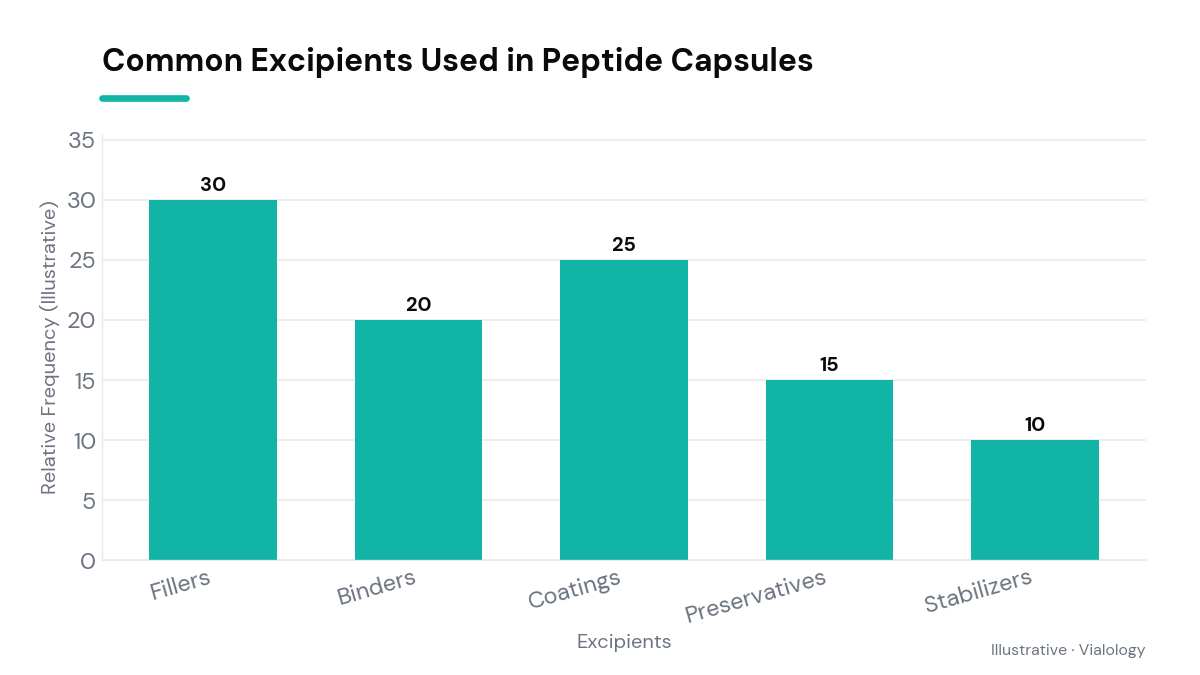
Oral delivery of peptides is notoriously difficult because the human gastrointestinal tract is designed to break down proteins into basic amino acids. To prevent premature degradation, researchers and manufacturers employ various inactive ingredients known as excipients. These substances serve multiple roles, acting as bulking agents to ensure consistent dosing, binders to maintain structural integrity, and enteric coatings to shield the peptide from harsh stomach acid. For those interested in the biochemical functions of these additives, excipients explained in scientific literature reveal how these seemingly passive ingredients actively dictate the bioavailability of the therapeutic agent.
Common excipients include microcrystalline cellulose, which acts as a reliable filler, and magnesium stearate, a lubricant that prevents ingredients from sticking during the manufacturing process. In modern peptide formulations, specialized permeation enhancers such as sodium caprate or SNAC (sodium N-[8-(2-hydroxybenzoyl) amino] caprylate) are also frequently categorized alongside excipients. These critical compounds temporarily open the tight junctions of the intestinal epithelium, allowing larger peptide molecules like oral semaglutide to pass safely into the bloodstream.
Overcoming the Gastric Barrier: Enteric Coatings and Acid Blockers
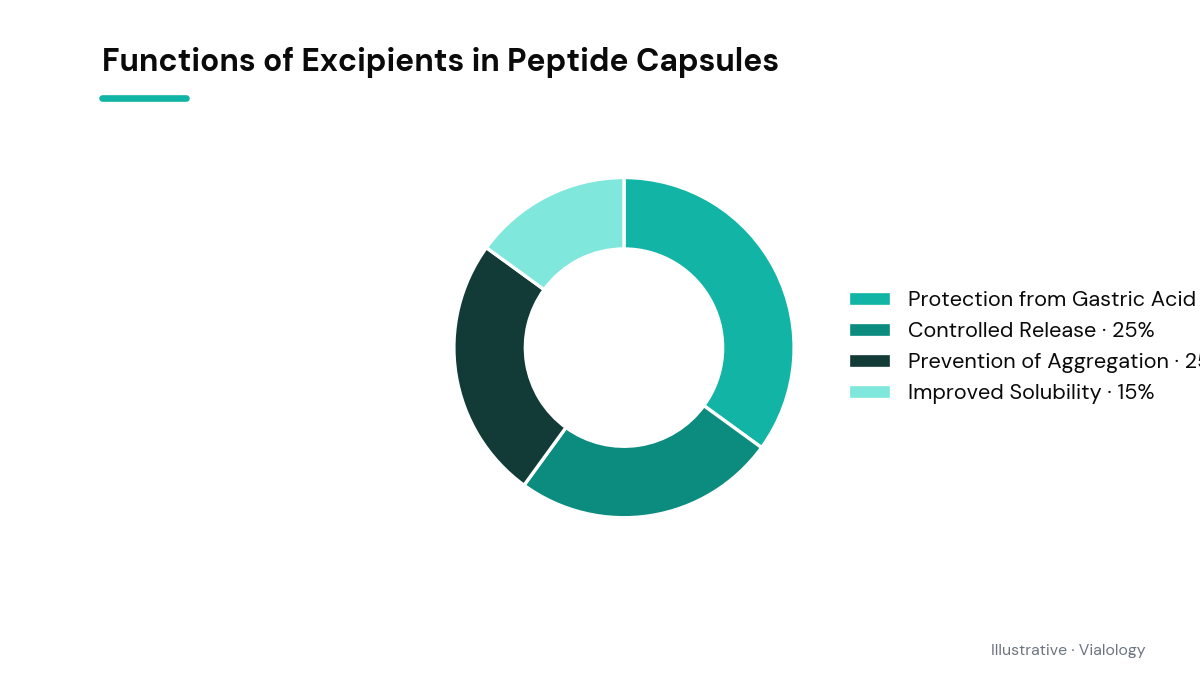
The stomach’s highly acidic environment, with a pH ranging from 1.5 to 3.5, represents the first major obstacle for oral peptides. Enteric coatings are specialized excipients applied to the outer shell of the capsule rather than mixed inside. Usually made of polymers like methacrylic acid copolymers, cellulose acetate phthalate, or shellac, these coatings are insoluble in highly acidic environments but dissolve rapidly when they reach the neutral-to-alkaline pH of the small intestine.
Beyond the capsule shell, internal excipients like citric acid are sometimes included to locally lower the pH in the microenvironment of the small intestine. This temporary, localized acidification deactivates brush border proteolytic enzymes that would otherwise rapidly cleave the peptide bonds. This sophisticated spatial and temporal control illustrates that excipients are not merely inert fillers, but highly engineered barriers designed to ensure the survival of fragile biomolecules.
Stabilizers, Fillers, and Preserving Peptide Bioactivity
Peptides are highly sensitive to environmental factors such as moisture, temperature fluctuations, and mechanical shear. Without stabilizers, a peptide can undergo aggregation, oxidation, or hydrolysis, rendering it inactive before it even reaches the digestive system. Excipients like mannitol, sorbitol, and various starches act as cryoprotectants and lyoprotectants, preserving the delicate three-dimensional structure of the peptide during freeze-drying and long-term shelf storage.
Furthermore, antioxidants like ascorbic acid or methionine are sometimes added to prevent the oxidation of sensitive amino acid residues, such as methionine or cysteine. By mitigating chemical degradation pathways, these stabilizing excipients ensure that each capsule delivers a precise, potent dose of the active peptide throughout its designated shelf life.
Related on Vialology
Frequently asked questions
Why do peptide capsules need so many inactive ingredients?
Peptides are highly fragile molecules that easily degrade in the stomach; inactive excipients protect them from acid, enhance their absorption through the intestinal wall, and ensure consistent dosing.
What is the most common permeation enhancer used in oral peptides?
Sodium caprate and SNAC are two of the most widely researched permeation enhancers used to help peptides cross the intestinal barrier.
Are the excipients used in peptide capsules safe?
Yes, the excipients used in commercially manufactured peptide capsules are generally recognized as safe (GRAS) by regulatory bodies like the FDA and are used in minimal, non-toxic quantities.
Educational use only. Vialology publishes journalistic and educational content about peptide science. Nothing here is medical advice, diagnosis, or treatment, and nothing should be taken as an endorsement to use any substance. Many peptides discussed are experimental and are not approved by the FDA for human use. Always consult a licensed healthcare professional before making any health decision.